
| ROACH |
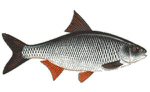
Current UK Record – Roach (Rutilus Rutilus) – 4lb 4oz – 2006 – Northern Ireland Stillwater.
Description and habitat
A moderately deep bodied fish with silvery white sides, dark brown or grey back with a bluish or greenish tint, red/orange eyes, large silvery scales and red lower fins, hence its nickname of ‘Redfin’. An average fish will be 6 – 8ins long. Grows to 4+lb, a fish over 2lb is considered a very good fish. and a 3lb fish considered a fish of a lifetime. Found just about everywhere. Lakes, ponds, rivers and canals.
Fishing Methods for Roach
Various methods including float, ledger or feeder but the float seems best. Light tackle is normally the order of the day, with small hooks. Roach love casters and many a match has been won with this bait but … roach have a crafty habit of stealing casters and leaving you with an empty half shell. If you bury the hook totally inside the caster, you may still be left with an empty half shell a few times, but stand more chance than if you hook it through the end of the caster. Another way, with maggots as well, is to hook the caster through the middle. Darker casters are more buoyant in the water, so these will balance out the weight of the hook, making them fall through the water at the same rate as your loose feed.
Heavy or pre-baiting with groundbait is notnecessary. It is best to feed groundbait sparingly, and use a fine groundbait to cause a ‘cloud’ in the water. Add a few hook bait samples to the groundbait, with crushed hempseed often attracting roach. Bites are very fast, so you have to be ready to strike.
Bread flake about the size of a thumbnail, squeezed onto a size 16 or 14 hook, often tempts the larger roach. Don’t squeeze the flake onto the hook too hard, because you want little bits to flake off to tempt the fish. If you retrieve your float and the bread is still on the hook you’ve squeezed it on to tightly !
Baits for catching Roach
Hempseed, Tares, bread (either punch, flake or paste), casters, maggots, pinkies, stewed wheat, cheese, small red worms, brandlings and bloodworm.
| RUDD |
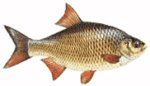
Current UK Record – Rudd (Scardinius Erythrophthalmus) – 4lb 10oz – 2001 – Northern Ireland Stillwater.
Description and Habitat
The body of the Rudd is flattened at the sides, the back is blue-green and the belly a silvery white. The dorsal and pectoral fins are reddish-grey, and all other fins are a deep red. Rudd are often confused with Roach but can be identified by the dorsal fin, which is set further back and starts behind an imaginary vertical line projected upwards from the pelvic fins. The eyes have yellow to orange irises compared to a Roach (which has red eyes) and the Rudd’s mouth curves upwards.
Rudd tend to be a shoaling fish usually living in the lower reaches of rivers, backwaters and ponds with plenty of aquatic vegetation and profusely overgrown.
Fishing Methods for Rudd
Fishing for Rudd is similar to fishing for Roach, and the baits used for catching Rudd are the same as for Roach. Float fishing with light tackle and small fine wire hooks is considered the best method for fishing for Rudd.
When fishing with casters the Rudd, just like the Roach, can bite at your caster and leave you with an empty shell. Burying the hook totally inside the caster is worth a try and might be the answer. Darker casters are more buoyant in the water, so choose these to balance out the weight of the hook, making the hooked caster fall through the water at the same rate as your loose feed.
When using groundbait it is best to use a fine groundbait to cause a ‘cloud’ in the water. With bread flake as the hook bait, use a small piece and don’t pinch it onto the hook too hard, because you want little bits to flake off and tempt the fish. If you retrieve your float and the bread is still on the hook, then you’ve squeezed it on to tightly !
Baits for catching Rudd
Small pieces of worm, small red worms, brandlings, bloodworm, bread (small pieces – either punch, flake or paste), casters, maggots, pinkies.
| PERCH |

Current UK Record – Perch (Perca Fluviatilis) – 6lb 3oz – 2011 – Sussex Stillwater.
Description and habitat
Nickname ‘Stripey’, the Perch has a flat-sided greenish body graduating down to a white belly. It has bright red/orange pelvic fins andnd two dorsal fins, with five or more broad black vertical stripes down the sides. It has a row of sharp pointed spines along the dorsal fin, so be careful when handling Perch. The body of the Perch is rough to the touch, as the small scales are imbedded deep in the skin.
The Perch will probably be the first fish a young angler catches, because they are a very aggressive predator that will bite at almost anything. Perch live in still, slow and fast running water, lakes, ponds, rivers and canals. They can be found where there is underwater obstacles or structures, tree roots, weed beds and overhanging trees, which are all good places to hide and ambush anything edible. Larger Perch will eat smaller fish such as minnows, roach, rudd and dace.
Natural food for Perch include; crustaceans, insects, flies, mayfly, caddis fly, larvae, worms and all fish fry. The average size perch is 4oz – 1lb, with anything over 2lb considered a specimen.
Fishing Methods for Perch
Perch can be caught using various methods including float, ledger, feeder, free-lining, spinning with lures, and even fly fishing. More perch are caught in summer months, but they can be caught throughout the year. A medium rod with a fixed spool reel fitted with a 3lb line, hook size of 16 – 10 depending on the bait used is OK. Often, the best bait for catching big Perch will be a lobworm hooked through the middle, with a small piece of rubber pushed onto the hook to prevent the worm slipping off. After hooking the lobworm I pinch off the tail of the worm, which releases a scent into the water, to hopefully attract Perch. Used in conjunction with chopped worm this is a often deadly combination.
On stillwaters, lakes and ponds, try float fishing using a waggler with a big lobworm on a size 10 hook. Plumb the depth and fish overdepth by 6 inches. Use chopped worm mixed in your groundbait and throw a couple of balls in to start. If you know there is an underwater feature in your swim, cast near to this. The chopped worm will attract the Perch which will hopefully take your lobworm. If you get no bites after a few minutes, try twitching your bait (reel in a couple of turns) this sometimes induces a Perch to take your bait.
A typical approach when Perch fishing in rivers or flowing waters is trotting. Use a stick float or in faster waters a big Avon or a Loafer that carries a lot of shot. The float and shotting pattern will depend on the speed of the water flow and where in the water the Perch are located. Plumb the water to get the depth, and start by stringing the shot out button style, and letting the float and baited hook flow at the same speed as the water. The baited hook needs to be in front of the float so hold back (stop the float) for a couple of seconds every couple of yards or so. This is because the current nearer the river bed is slower than on the surface, so holding back the float will allow the baited hook to stay in front.
Feed chopped worm every second or third cast to attract the Perch. After a few run throughs, if you get no bites then try altering the shot by moving it nearer the hook, or bunching every second shot together. If fishing a fast flowing water try using an Avon type float and fix the shot nearer the hook, to keep it closer to the river bed. Another method is free-lining, which is OK where there is little flow on the water. Attach a single swan shot (SSG) about a foot up the line from the hook, and again fish a large lobworm on the hook. The lobworm will bounce along the river bed and hopefully be intercepted by the Perch. A feeder rod may also be used. Make sure you use enough weight to hold the bait on the bottom of the river bed. Start with a 24 inch hook length, bait your hook with a lobworm , fill your feeder with groundbait containing chopped worm and cast in.
Perch can also be caught using plugs and spinners. Spinning is a good way of fishing for larger Perch. It allows you to move up and down the water, and find where the fish are.
Baits for catching Perch
Worms, lobworms, dendrobaena worms, red worms, brandlings, minnow, casters, maggots. Also caught using plugs, lures and spinners. The Perch may also be caught on flies used by trout fishermen.
| BREAM (COMMON OR BRONZE) |

Current UK Record – Bream (Abramis Brama) – 22lb 11oz – 2011 – Cambridgeshire still water.
Description and habitat
Adults are deep bodied and bronze in colour with darker, sometimes black fins. The Bream has a deep laterally compressed body with a prominent covering of protective slime. It has a long anal fin compared with the dorsal fin, a forked tail and a relatively small head and mouth with a protruding upper jaw. Young Bream up to approximately 8oz. are known as ‘skimmers’ and are more silvery in colour but turn a darker bronze colour as they mature.
Often small bream are mistaken for the Silver Bream (Abramis Bjoerkna). The Silver bream is smaller than the common, or bronze bream, and is silver in colour with red anal and pectoral fins. An average Common Bream will be 12 – 14 inches. Bream may occasionally grow to 15+lb, but any fish over 4lb is considered a good one. Well liked by match anglers because Bream are a shoal fish and therefore a good chance of catching more. Larger Bream are nicknamed ‘slabs’ or ‘dustbin lids’.
Found in lakes, ponds, rivers and canals but more often found in still waters. During spawning from May to June, the male Bream develops white tubercles covering the head and upper body. Bream often interbreed with other species, creating hybrids such as Roach/Bream or Rudd/Bream crosses.
Bream are predominantly bottom feeders, travelling in shoals, rooting around and feeding in the soft bottom of ponds, lakes and the lower reaches of rivers. They feed extensively on algae, plankton, insect larvae, pea mussels, crustaceans and molluscs, also grubbing around among the bottom debris for the many micro-organisms which live there. Once feeding, the shoal of Bream move across the bottom denuding the bottom of food.
If the shoal is large and feeding in earnest it will stir up a great deal of mud and the gases released will carry the colour to the surface and discolour the water. For locating Bream this is worth noting.
Early morning or dusk are good times to fish as the Bream move in closer to the margins as the sunlight fades.
Fishing Methods for Bream
Various methods including float, ledger or feeder but the feeder is considered the best method. Bream can be voracious feeders mainly feeding on the bottom. They respond well to groundbaiting so if you can, pre-bait the area you are going to fish. Lay a bed of groundbait using brown crumb or continental groundbait with sweetcorn, casters, chopped up worms and some of your hook bait mixed in. Don’t start balling it in when you start catching Bream, as this can scare them off. Large catches have resulted from laying down a carpet of groundbait which holds the shoal in the area.
Once a fish is hooked it needs to be pulled away from the shoal quickly otherwise the shoal will be spooked and will move on. As a guide a 4 lb main line with 2.5 lb hook length and size 16 hook is adequate. Accurate casting is essential to keep all your bait going into the same area. Laying on (fishing overdepth – i.e. in 6 foot of water set your float 8 foot from the hook) is a good tactic when fishing for Bream.
When feeder fishing use an open-end feeder filled with a groundbait mix with some of your hook bait mixed in and a hook length of 18 – 24 inches. When you cast in and the feeder has reached the bottom, wind up the slack in the line then wind in a bit more till there is a sleight bend on your rod tip. Bream bites are noticeable when float fishing by the slow disappearance of the float or when ledger / feeder fishing by the steady pull round of your rod tip.
Bream are not known as a fighting fish and generally after a few ‘nods’ (tugs on the line as you reel in) come to the net with little resistance.
Baits for catching Bream
Worms, lobworms, small red worms, brandlings, bloodworm, bread (either punch, flake or paste), casters, maggots, gozzers, pinkies and sweetcorn.
| TENCH |

Current UK Record – Tench (Tinca Tinca) – 15lb 3oz – 2001 – Surrey stillwater.
Description and habitat
Tench are easily identified by their thick set, well rounded, dark olive green coloured body. The scales are very tiny which give them the appearance of actually being scale-less. The fins are rounded and the caudal fin is large almost unforked. The sexes can be distinguished by the shape of the pelvic fins on the underside of the body.
Male Tench have very large round shaped fins and those of the female are more triangular in shape and longer. An average fish will be 12 – 16ins. Grows to 15+lb, with a fish over 5lb considered a good fish. There are also golden, yellow and orange Tench, but these are mainly found in ornamental ponds.
The Tench used to be called the ‘doctor fish’ because other fish would deliberately rub against them and be cured of their ailments with the slime from the Tench which was thought to have healing properties.
Found in lakes, ponds, slow running rivers and canals but more often found in still waters.
Fishing for Tench
The first thing to consider when going Tench fishing is where you are going to fish. Most lakes, ponds and canals have tench in them but choosing a water known to hold a good head of Tench puts the odds of you catching one in your favour. Make enquiries with local anglers, fishery owner or bailiff as to which is the favoured peg, best method and baits for catching Tench from your chosen water. If you haven’t got any information for whatever reason have a walk round and look for signs of tench or a likely place to fish for them. Tench are known to feed in the margins, among reeds, lily beds and other features.
The best time to catch tench is either early dawn or at dusk and through the night. Tench feed almost exclusively on the bottom and like to root about in the mud and weeds looking for snails, grubs and anything else they can eat. You can spot Tench feeding by the stream of tiny bubbles that can be seen bubbling on the waters surface and / or the muddy area of water discoloured by the tench rooting in the mud for food.
Tip: Raking – But ask the fishery owner first and if you are allowed to. Take a rake with you, and before you set up you rods or do anything else rake around the bottom of your swim. Tench are attracted to this and they love searching the murky water of a freshly raked swim for unearth snails, worms and other food
Fishing methods for Tench
Tench respond very well to groundbaiting so if you can pre-bait the area you are going to fish beforehand you will have a better chance of catching. Start by laying down a bed of groundbait using brown crumb or continental groundbait with sweetcorn, casters, chopped up worms and some of your hook bait mixed in. Other combinations can also be used for groundbait and hemp and particles are a good choice.
Tench seem to prefer a sweet bait and some anglers add molasses, a sweet syrup, to their groundbait or other sweet tasting additives. This is not a hard and fast rule though; if you want to try savoury or spicy baits there is nothing stopping you.
Tip: If using maggots mixed in with your groundbait try adding some dead ones as well, as these will not bury themselves in the mud.
Once I have laid a bed of groundbait, adding more feed into the water depends on if I am float fishing or feeder fishing. If float fishing, loose feed little and often depending how often you are getting bites. If bites are few, slow down or hold back on loose feeding. If using a feeder, add loose feed only rarely.
Tench can be caught using any method of fishing. Some anglers prefer using a maggot feeder or method feeder and sit waiting for that slow pull round of the rod tip to say there is a fish in. Other anglers prefer to float fish with either a rod or pole.
As mentioned, Tench love patrolling the margins and around lily beds and reeds so float fishing with a waggler, set slightly over depth, close to reeds is a good proven tactic. Tench bites are usually a couple of knocks or small lifts on the float then it slides away slowly under the water. Don’t strike too soon, wait for the bite to develop properly. Wait for the float to disappear completely before striking. Tench are hard-fighting fish and strong tackle is advised.
Baits for catching Tench
Worms, lob worms, redworms sweetcorn, bread (either punch, flake or paste), maggots (red are often best), pinkies, casters, mini-boilies, pellets, prawns, cockles and mussels, fresh not frozen or pickled in vinegar).
As with all fishing, if you are not catching using one method or bait try another. Do not be afraid to try something different.
Note: When you have caught a Tench, as with all fish, handle it carefully. Do not use a towel, cloth or anything similar to hold it in. Doing this will remove the protective mucus from the fishes body and can seriously harm it
| CARP |
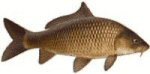
Current UK Record – Carp (Cyprinus Carpio) – 67lbs 8oz – 2008 – Ashford, Kent.
A bit of Carp History
It was in the early 1300’s that Carp were introduced into England and Wales from mainland Europe, imported by monks as a food source, and reared in stew ponds. Today, Carp are found in almost every river, lake and pond in the country. In the early years Carp were difficult to catch. As Isaac Walton wrote in his book, ‘The Compleat Angler’, “And my first direction is, that if you will fish for a Carp, you must put on a very large measure of patience, especially to fish for a river Carp. I have known a very good fisher angle diligently four or six hours in a day, for three or four days together, for a river Carp, and not have a bite. And you are to note, that, in some ponds, it is as hard to catch a Carp as in a river.”
Over the years Carp angling became more popular and anglers set out specifically to catch Carp. In 1952 the legendary angler Richard Walker caught Britain’s first 40lb carp in Redmore Pool. Now Carp are one of, if not the most, sought after fish by anglers, with anglers concentrating solely on Carp.
Description of and habitat
There are different variants of Carp, the main being:-
Common Carp – fully scaled Carp
Mirror Carp – scaled with large, uneven mirror like scales. Where there are no scales the body is smooth.
Linear Carp – scale less except for a row of large scales that run along the lateral line on both sides.
Leather Carp – smooth bodied, virtually unscaled except near dorsal fin.
Grass Carp – similar to the Common Carp but normally has a longer, thinner body.
Ghost Carp – same as the Common Carp but it is all white with two black eyes.
Koi Carp – this is more of an ornamental fish. Similar to the Common Carp, but its colours include orange, black, red, yellow, and a combination of these colours.
Reasoning behind the variants (allegedly … or maybe just a myth !!)
Carp were bred by the monks in ‘stew’ ponds and bred for eating. Descaling them was quite a task that no-one liked, so they were bred with less scales (= less messing about descaling).
Similar to the barbel, the Carp has four barbules its mouth. It brown to greenish brown or golden brown in colour with a lighter brown, cream underside. Leather Carp and Mirror Carp are usually a darker colour than the Common Carp. Carp are amongst the longest living fish species in the Britain and live up to around 20 years of age but carp of 60 years have been recorded.
Carp are found in all waters, but are fished for predominantly in stillwaters. They feed extensively on bottom living invertebrates, fresh water shrimp, snails, insect larvae, caddis larvae, nymphs, crustaceans and molluscs, grubbing around among the bottom debris for the many micro-organisms which live there. They will also consume water plants and fish fry.
Fishing Methods for catching Carp
Carp are caught using various methods including float, ledger or feeder. The feeder or ledger is generally the first method anglers try when fishing for Carp, and is a popular method used by specimen anglers fishing for Carp. There are also many baits for catching Carp and some anglers swear by the use of boilies. Although boilies are a good bait, don’t overlook the other baits such as sweetcorn and those listed above.
A guide to the basic tackle needed for carp fishing is; a rod with a 2 lb test curve (or a heavy feeder rod) fitted with a fixed spool reel filled with 10 lb main line and 18 – 24 inch 4 lb hook length and larger hook (6 to 12’s). Throw some ‘free’ offerings into the water where you are about to fish, then get tackled up. If feeder fishing, bait your hook and use an open-end feeder filled with a groundbait mix with some of your hook bait mixed in. Cast in over the free offerings and when the feeder has reached the bottom, wind up the slack in the line then wind in a bit more till there is a sleight bend on your rod tip.
Baits for catching Carp
Luncheon meat, boilies, trout pellets, Chum mixer or any other dog or cat biscuits, tiger nuts, peanuts, maize, worms, dendrobaena worms, red worm, brandlings, bloodworm, bread (either crust, punch, flake or paste), casters, maggots, pinkies, and sweetcorn. Carp are also caught using a floating bait like bread crust.
Carp respond well to groundbaiting so if you can, pre-bait the area you are going to fish. Lay a bed of groundbait using brown crumb or continental groundbait with hemp or sweetcorn, casters, chopped up worms or a mix of these and some of your hook bait mixed in. Tiger nuts and peanuts are also used for groundbaiting but these should be thoroughly soaked beforehand.
Note : Always carry and use an unhooking mat for unhooking larger Carp.
| CRUCIAN CARP |

Current UK Record – Crucian Carp (Carassius Carassius) – 4lb 9oz – 2004 – Yateley Lake.
Description and habitat
The Crucian Carp (Carassius Carassius) is amongst the smallest members of the family Cyprinidae, which includes other fish such as the Common Carp. Although of the same family as the Common Carp, the Crucian Carp is different in that it doesn’t have barbules and rarely reaches a weight above 3.5lb (1.58 kg).
Crucian Carp vary in colour from gold to bronze but mainly have a brownish colouring across the back with gold or greyish green sides leading down to a yellowish or white belly. They usually have a very rounded body with a covering of small scales in an even pattern and the reddish fins of the Crucian are rounded with a convex dorsal fin. They were believed to have been imported from Germany, around the 18th century.
The Crucian Carp is a very hardy and extremely adaptable fish, able to survive in ponds and lakes with poor water quality with little oxygen that would prove fatal to most other species. They spawn mainly on water plants around the months of May to June. The eggs hatch within a week but the fish stay attached to the plants for two or three days to feed on the yolk sack before swimming off. When they are older they usually swim in shoals of fish of around the same age and weight.
Natural food of the Crucian Carp include insect larvae, small crustaceans, zooplankton and fauna. Although mainly a bottom feeder, The Crucian Carp will feed at all levels and are often seen taking small insects from the surface of the water during sunny days.
Fishing Methods for catching Crucian Carp
As with all fish, Crucian Carp can be caught using all methods of angling including float, ledger or feeder but the float seems best by far. Light tackle is the order of the day, fished on or just off the bottom near reeds or around surface plants.
When fishing with casters the Crucian can bite at your caster and leave you with an empty shell. Burying the hook totally inside the caster is worth a try and might be the answer. Darker casters are more buoyant in the water, so choose these to balance out the weight of the hook, making the hooked caster fall through the water at the same rate as your loose feed.
When using groundbait it is best to use a fine groundbait to cause a ‘cloud’ in the water. With bread flake as the hook bait, use a small piece and don’t pinch it onto the hook too hard, because you want little bits to flake off and tempt the fish. If you retrieve your float and the bread is still on the hook, then you’ve squeezed it on to tightly !
Baits for catching Crucian Carp
The most common baits to catch Crucian Carp on are maggots, casters, bread (either punch, flake or paste), pinkies, small red worms, brandlings, bloodworm, sweetcorn, small pieces of cheese and small pieces of diced luncheon meat.
| BARBEL |

Current UK Record – Barbel (Barbus Barbus) – 21lb 1oz – 2006 – Great Ouse.
Description and habitat
The Barbel is light brown to greenish brown with yellowish sides, with darker fins, except for the pectoral, pelvic and anal fins, which are yellowish orange. The body of the Barbel is elongated with very small scales and appears scale less. There are 55 to 65 scales in the lateral line of a Barbel’s body.
The head of the Barbel is pointed and its eyes, which are rather small, are set high on the sides of the head. The Barbel is recognised by its underslung mouth, with thick lips with two short barbules on the top lip and two longer barbules at the corner of its mouth. These barbules have taste and touch cells, and help the fish to locate food on the riverbed, where barbell are most usually found.
Barbel spawn in late spring in rivers and streams between May and July, and when the eggs are fertilized by the males they take around 10 to15 days to hatch. The small hatchlings of a quarter of an inch long remain in the gravel for three or four days and live off their yolk sacks, then form shoals moving into slacker areas, where they live off small particles of food.
Barbel are predominantly bottom feeders, rooting around and feeding in the gravel bottom of rivers. They feed extensively on bottom living invertebrates, fresh water shrimp, snails, insect larvae, caddis larvae, nymphs, crustaceans and molluscs, grubbing around among the bottom debris for the many micro-organisms which live there. They grow fairly rapidly, and mature when they are five or six years old, with females larger than males. Barbel grow to over 20lbs, with a fish over 7lb considered a good fish, and a 10lb barbel a specimen.
Barbel are much sought after by anglers, due to their hard fighting qualities. They are large powerful fish, with the shape of its body perfect for living in fast flowing waters, and are regarded as the hardest fighting coarse fish in the river. Like the carp angler, many anglers devote all their time in pursuit of the Barbel.
When you hook your first Barbel, you are unlikely to forget it because it usually tears off like a steam train. If you are not tackled up with the correct gear you will have little chance of stopping it, let alone landing it. they do not give up easily and fight with great determination, so fishing tackle is needed to match the fish’s power.
Although Barbel are caught all year round, they are more of a summer and autumn fish. During the summer months, Barbel can be found in weir pools and the faster stretches of water. During the winter months they favour the deeper, more slower waters.
In recent years, Barbel have been specifically bred for stocking in still waters. These fish seem to flourish even in less oxygenated waters than their normal river habitat.
Fishing Methods for catching Barbel
Barbel can be caught using various methods, including float, ledger or feeder, but the feeder is considered the best method. They normally inhabit strong, fast flowing waters, so a good rod with a fixed spool reel fitted with a minimum of 6lb line should be used. Hook size will depend on the size of the fish and the size of the bait used, but hook sizes are usually no smaller than a 12’s.
If legering, use a weight or feeder heavy enough that it will hold the bait close to the river bed. The weight will be determined by the strength of flow of the water. A typical approach when Barbel fishing is to use a swimfeeder or blockend feeder on the 6lb.mainline, with a 24 inch 4lb hook length and size 10 hook, baited with a large piece of luncheon meat. When float fishing in faster waters, try using a big Avon or a Loafer that carries a lot of shot. Fix the shot near the hook to keep it closer to the river bed.
Baits for catching Barbel
Luncheon meat, sausage meat, cheese and cubes of cheese, worms, dendrobaena worms, red worms, brandlings, grubs, bread (either crust, flake or paste), casters, hemp and caster, maggots, pinkies and sweetcorn and boilies have all proved to be successful in catching Barbel.
Advice
When a Barbel is hooked, it will NOT give up easily, and it will fight until it is exhausted. Try to land and unhook the Barbel quickly. When landed and unhooked, hold the Barbel in the flowing water, facing upstream until it is ready to swim away. This can sometimes take between a couple of minutes and 15 minutes or even longer.
| CHUB |

Current UK Record – Chub (Leuciscus Cephalus) – 9lb 5oz – 2007 – Southern Stillwater.
Description and habitat
Nicknames include “Old Rubber Lips”, Loggerhead, Chavender and Chevin.
The Chub is mainly a river fish, found in slow moving rivers to the faster moving rivers and weirs, especially where trees or bushes overhang the water. It may also found in ponds and lakes, and is now being stocked in commercial fisheries.
The chub is a thick set fish with a large blunt head. It has a long and cylindrical body, with large greenish/brown scales that have a slight black edging across the back, working down to a lighter golden flank and a light belly with a dark brown or black tail. The dorsal fin of the Chub is a greyish/green colour, with all the other fins being orange/red.
It has a large mouth with thick rubbery lips, a voracious appetite, and will eat almost anything. When smaller, the Chub is sometimes mistaken for Dace, as both the Chub and the Dace have similar body and fin colouring. Identification is by the shaping of the dorsal and anal fins, the Chub having convex shaped fins, while the Dace’s are concave.
Small Chub often swim in shoals, but as they grow the larger specimens usually become solitary. An average size Chub is 2½ to 3lb. Natural food for Chub include invertebrates, crustaceans, insects, flies, mayfly, caddis fly, larvae, worms, fish fry, berries from overhanging bushes i.e. elderberry. Larger Chub will eat smaller fish such as minnows, roach and dace. Chub are known for being gluttonous and will eat just about anything.
Unlike other fish the Chub will feed throughout the year, be it a hot summer afternoon or freezing winter morning.
Fishing Methods for catching Chub
Chub can be caught using various methods, including float, ledger, feeder, free-lining, spinning with lures and even fly fishing, the venue determining the best method. A medium rod with a fixed spool reel fitted with a minimum of 3lb line should be used. Hook size should be a 16’s or larger, depending upon the size of the bait used.
A typical approach when Chub fishing on rivers or flowing waters is trotting. Use a stick float, or in faster waters a big Avon or a Loafer that carries a lot of shot. The float and shotting pattern will depend on the speed of the water flow, and where in the water the Chub are located. Plumb the water to get the depth, and start by stringing the shot out button style, letting the float and baited hook flow at the same speed as the water.
The baited hook needs to be in front of the float so hold back (stop the float) for a couple of seconds every couple of yards or so, as the current nearer the river bed is slower than near the surface. When trotting, remember to feed every cast.
After a few run-throughs, if you get no bites then try altering the shot, by moving it nearer the hook or bunching every second shot together. If fishing a fast flowing water try using an Avon type float, and fix the shot nearer the hook to keep it closer to the river bed.
Another method is free-lining, which works where there is little flow on the water. Attach a single swan shot (SSG) about a foot up the line from the hook, and fish a large piece of luncheon meat or bread. The bait will bounce along the river bed and hopefully be intercepted by the Chub.
A feeder rod can also be used, but make sure you use enough weight to hold the bait on the bottom of the river bed. Start with a 24 inch hook length, bait your hook, fill you feeder with maggots or casters, and cast in. If after a few casts you don’t get a bite, then vary the hook length from the feeder until you start getting bites.
Chub may also be caught on plugs and spinners. On slower moving rivers / waters, you may also consider trying fishing floating crust, which can be a perfect approach on its day. Chub love bread, so don’t be afraid to use quite large pieces.
Baits for catching Chub
Worms, lob worms, redworms, cheese (especially the smelly cheese), cheese paste, bread (either crust, flake or paste), maggots, pinkies, casters, pellets, hemp and tares, wasp grubs, slugs and black slugs are good chub baits, as are sweetcorn, luncheon meat, sausage meat, berries and elderberries, shrimps, cockles (fresh not frozen or pickled in vinegar) and boilies. For the bigger Chub, use a bigger bait. They may also caught using plugs and lures, and even by fly fishing.
A Couple of Tips
- Tackle up away from your peg, because Chub are very wary fish and can soon be scared away. The vibrations you make next to the water can frighten the Chub away, and when you are standing near the water your profile against the skyline can scare them away.
- Once hooked a Chub will swim straight for any rushes or underwater obstacles, such as submerged trees or tree roots, and attempt to snag you up.
| IDE (SILVER ORFE) |

Current UK Record – Ide (Leuciscus Idus) – No UK Record (not a UK native fish).
Description and habitat
The Ide or Silver Orfe is a freshwater fish which originated across northern Europe and Asia, where it occurs in larger rivers, ponds, and lakes, typically in schools. The name is from Swedish “id”, originally referring to its bright colour. It has been introduced into the UK in recent years.
The Ide’s body has a typical cyprinid shape, and generally silvery appearance, while the fins are a pinkish red in varying degrees, and the tail and backfin may be greyish. In older and bigger fish, the body colour may turn to yellow/bronze. The Ide reaches a maximum length of about 60–80 cm (24–31 in), though the average size is about 40 cm (16 in). The ide may reach a weight of about 9 pounds (4.1 kg).
Ide are predators, eating insects, crustaceans, molluscs, and small fish. In the spring, they move into rivers to spawn over gravel or vegetation. The eggs may be found sticking to stones or weeds in shallow water.
The Golden Orfe is a variant of the Ide, originally bred for aquariums, with an orange back with black spots, turning to silver underneath.
Fishing Methods for catching Ide
I summer the Ide is naturally an “up in the water” type of fish, which can make the pole fished shallow a very effective way of catching.
In winter, Ide will still feed confidently, but you may need to fish on the bottom. A rig dropping through the water will help you find what depth the fish are at, which is usually the warmest layer.
Baits for catching Ide
Casters are the ideal bait for feeding shallow, especially in the summer, as they make a fish attracting noise when they hit the water, and Ide seem to have a taste for them. A small section of worm on the hook makes a good bait, as it is much more durable than a caster, and when you’re bagging, you can often catch two or three fish on the same piece of worm.
In the winter months, maggots make brilliant bait for catching Ide. Nuisance fish are not so much of a problem in the winter, and maggots do catch everything that swims. Feeding small amounts of bait regularly is a great way of keeping Ide coming. They are greedy fish, similar to chub, and in a good session you can get through some bait. When accuracy isn’t important, a catapult is a quick and effective way of feeding. When the fishing is slower and harder, a small pole mounted pot is an accurate and better way.
In open water, Ide can often be caught at close range, 4-8m out. On certain venues, pellets are a good bait to target Ide with, as they are so used to eating them if a lot of carp bait is going in.